A strong animation starts with a razor-sharp briefing and a script that does exactly what it needs to do: explain, persuade, and activate. In this guide, you will learn how to complete your briefing, structure your animation script into scenes, and how to smartly utilize narrative style, tone of voice, and audio. At Animation Agency in Amsterdam and Eindhoven, this is how we work on 2D and 3D explainer animations every day.
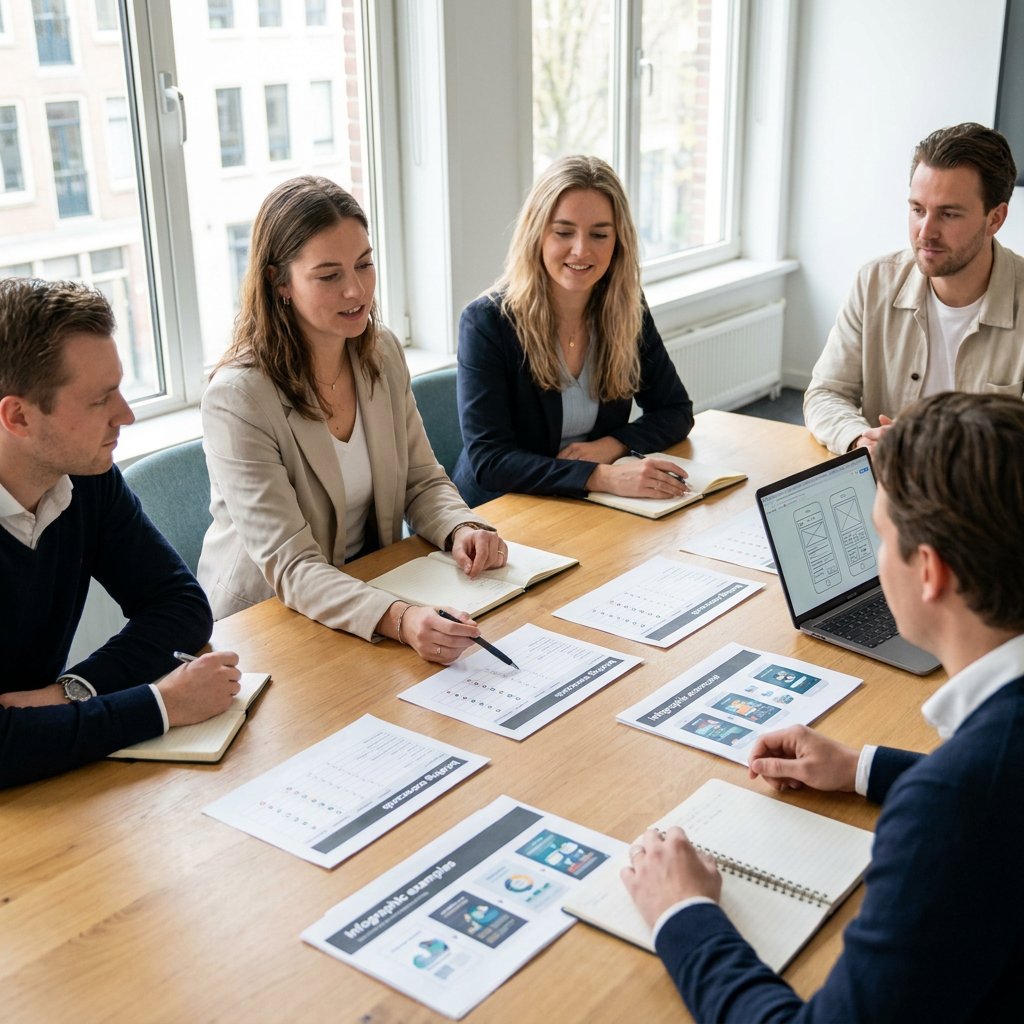
A good briefing shortens turnaround time, prevents misunderstandings, and takes your animation to the next level. Answer these questions, and your script instructions will be rock solid.
Tip: Summarize your answers on one page. This forms your script briefing, storyboard instructions, and guideline for production and revisions. Unsure if animation is the right medium for your goal and target audience? Briefly compare your case study to the questions above, and you will see immediately. You can find more practical guidance in the article Briefing an animation agency: how to draft a strong briefing.
Write your animation script in scenes with fixed columns: voice-over, image, movement, on-screen text, and audio. Work towards one micro-message per scene. Use show, do not tell: visually demonstrate claims with metaphors, icons, or mini-demos. Keep voice-over text short and conversational; on-screen text is only for keywords and numbers, not as a subtitle. For concrete writing techniques, see writing a script for an animation video.
Timing and readability are crucial. Calculate 130-160 words per minute, scenes of 4-8 seconds, and sufficient pauses for key points. Place screen text safely within titler-safe and avoid typography that is too small. Present the CTA both visually and verbally. Finally, create a storyboard or animatic to validate timing, rhythm, and visual direction with stakeholders early on. Want to go through the entire workflow? Check out the step-by-step plan for instructional animation.
Make complex information clear, understandable, and convincing
Choose a narrative style that suits the purpose and target audience. Possible forms:
Are you creating task-oriented instructions? Watch the software tutorial animation for a step-by-step approach.
Align your tone of voice with this. Finance often calls for clarity and reliability, healthcare for warmth and reassurance, and high-tech for sharpness and precision. Write directly, actively, and in the second person ("you"). Prioritize benefits over features and conclude every storyline with a clear next step. Looking for inspiration? Check out examples of instructional animations and best practices.
Write as you speak: short sentences, one idea per sentence. Eliminate subordinate clauses, filler words, and repetition. Replace jargon with concrete examples or explain it briefly. Vary sentence length for rhythm and read your visual aid aloud to test tempo and naturalness. Every sentence must contribute to the goal and CTA. Avoid common missteps with this overview of common mistakes in instructional animations.
Audio supports emotion, tempo, and accents. Choose music that carries the storyline, not dominates it. Always mix the voice-over to lead and sidechain music where necessary. Use SFX sparingly for interactions, transitions, and key moments. Arrange licenses in a timely manner and consider a sonic logo or audio sting for brand recognition. Read more about voice-over and audio design for instructional animations.

Is your question not listed? Feel free to ask.
Ask your questionStart with a core message and a concrete KPI. Create an outline with scenes and link one goal to each scene. First, write the voice-over in conversational language, check for 130-160 words per minute, and only then add on-screen text and visual notes. Test with an animatic and refine until every scene adds value.
Answer objective, target audience, core message, problem-solving, proof, CTA, channel, length, tone of voice, jargon, visual direction, and preconditions. Keep it concise yet concrete, include example links and brand assets, and conclude with success criteria and a schedule. This allows your studio to get started quickly and efficiently. Would you like us to develop and produce this for you? We are happy to help.

Whether it concerns an ambition, product, process, technology, or idea: we make visible what makes it special and translate it into imagery that is clear, convincing, and impossible to ignore.