
What is science communication?
Science communication is the understandable, relevant, and target-group-oriented sharing of research with people both inside and outside the academic world. It is therefore not just about transmitting knowledge, but also about relationship building, outreach, and choosing a format that suits the audience. Below, you can see which target groups, formats, skills, and support routes occur most frequently.
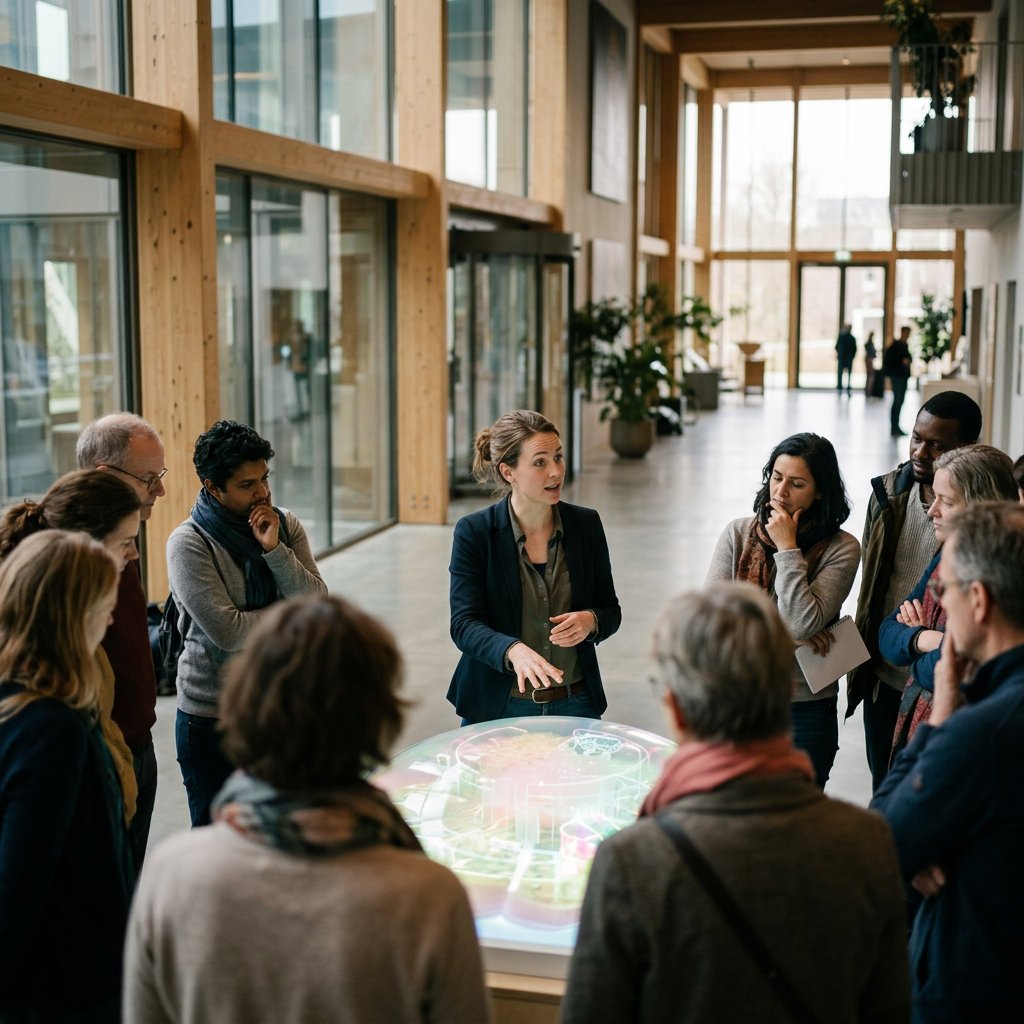




Why the bridge between research and society does not form automatically
Research only gains societal significance when people understand why it matters. Science communication therefore strengthens the relationship between science and society, not just the dissemination of results. For researchers and knowledge institutions, outreach and public engagement are increasingly part of their work. Science communication often revolves around simplifying complex information—for example, with an infographic for complex information or an explainer animation —so that content, context, and language align with the audience's situation.
Target groups determine the tone, channel, and depth
| Target group | What often works | Suitable shapes |
|---|---|---|
| Adults | Relevance, context and recognizable examples | Lectures, articles, podcasts, public meetings |
| Children and young people | Brief explanation, interaction, and experience | Workshops, demonstrations, educational activities |
| Education | Clear structure and applicable content | Guest lectures, teaching materials, meetings with researchers |
| Researchers or peers | More nuance, method, and depth | Presentations, papers, seminars, pitches |
From lecture to infographic: which format suits which purpose?
| Form | Especially suitable for |
|---|---|
| Writing and science journalism | Explanation, nuance, and depth |
| Presenting and pitching | Grab attention and sharpen the core message |
| Social media | Reach, visibility and accessible interaction |
| Storytelling and design | Making abstract information understandable and memorable, for example through data storytelling |
| Infographic or animation | Visually explaining complex, technical, or data-intensive topics, such as data visualization |
From a standalone activity to a well-thought-out approach
A strong approach starts not with a channel, but with a communication question: what does the audience need to understand, feel, or do? From there, it helps to explore multiple options, such as an introductory course or trying out various activities. For partners, decision-makers, and funders, infographics for stakeholder communication well to clearly share impact, conclusions, and decision points. Theory, practice, and a concrete end product reinforce each other. In this way, individual actions contribute to a broader and more structural outreach strategy.
Make complex information clear, understandable, and convincing
Skills and learning pathways that help researchers advance
- Introductions often cover communication theory, target audiences, best practices, literature, outreach, and message hierarchy in technical communication.
- Targeted skills training focuses on writing, presenting, social media, pitching, storytelling, design, and data visualization.
- More intensive programs, such as workshops or summer schools, combine practice with feedback and product development.
- The best learning path depends on experience, the learning objective, and the communication tool someone wants to create.
Support, networks and programs in the Netherlands
- Support often starts within the institution itself, via universities, graduate schools, or hubs for citizen science and public engagement.
- National trade and professional networks help build knowledge, examples, and contacts.
- Meetings and activities are valuable for meeting like-minded people and learning about new forms of science communication.
- In the Netherlands, also search under broader labels such as public engagement, outreach, research communication, and themes related to NWO science communication.





Ready to take your A to AA?
Whether it concerns an ambition, product, process, technology, or idea: we make visible what makes it special and translate it into imagery that is clear, convincing, and impossible to ignore.