
CPQ configurator visuals: what they are and when they add value
CPQ configurator visuals are the visual layer on top of configuration, pricing, and quotation logic. As a user selects options, not only does the appearance of the product change, but also what can be configured and quoted technically, commercially, and operationally. This adds significant value, especially for complex physical products: shape, size, material, layout, and compatibility become immediately visible. The nuance is important: a convincing visual does not automatically make a configurator reliable. If rules, prices, approvals, or output are incorrect, errors will still occur further down the line in sales, operations, or delivery. With many variants, well-thought-out Variant Management in 3D product visualization keep the logic and management scalable.
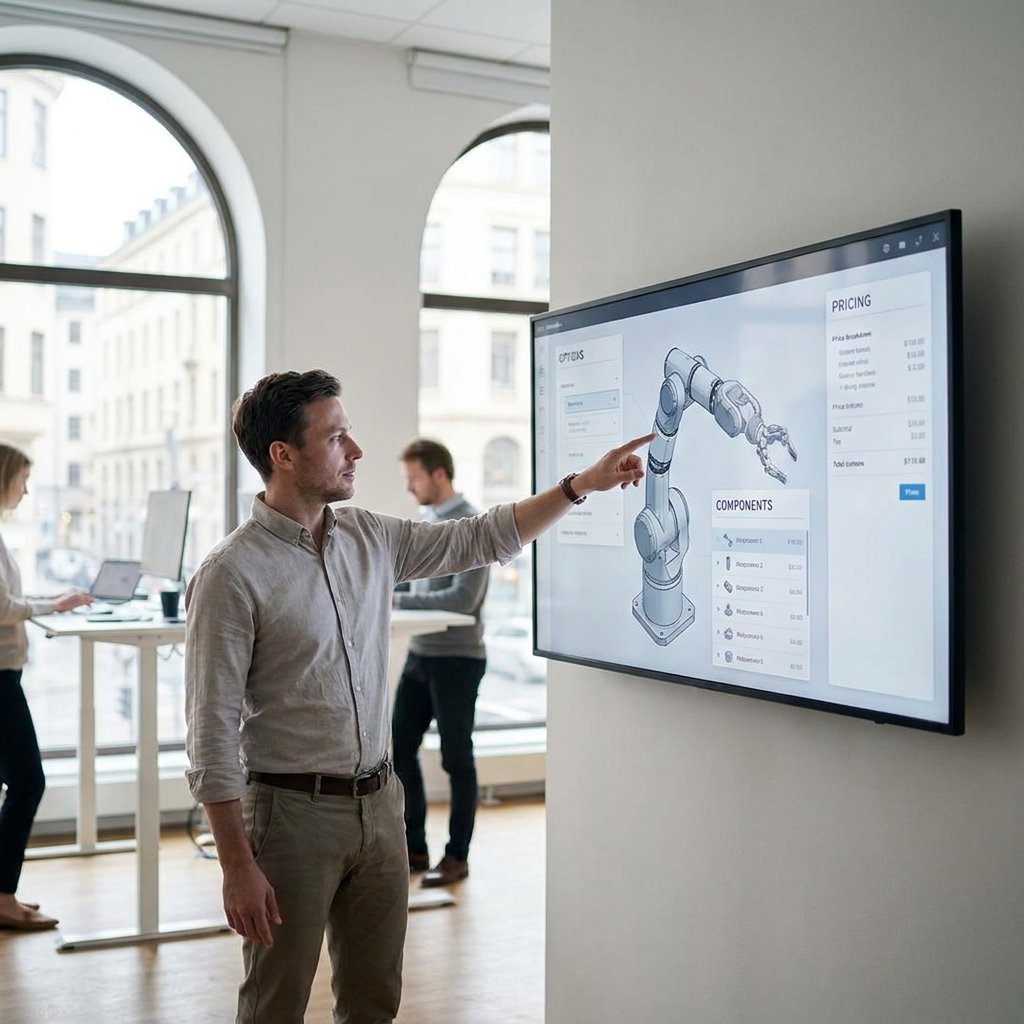




From choice to quotation: how the visual layer works in CPQ
In a CPQ environment, the visual changes with every choice, so that a buyer or sales representative immediately sees what an option means for finish, dimensions, material, or accessories. The usual flow is simple in design: first find the right product, then select options, subsequently show only valid combinations, and generate an RFQ or quotation from them. In some processes, the user can then proceed independently in self-service. The goal is therefore not just an attractive screen or strong interface visualization, but above all faster decision-making, less coordination with specialists, and fewer errors in the quotation process. See Automating quotation visualizations for examples of automation in the quotation process.
When visuals make the difference and when rules are more important
Visuals are not equally decisive in every CPQ process. The context determines whether the greatest gain lies in understanding what you are choosing or in monitoring complex commercial and operational rules.
| Situation | Where visuals add significant value | Where rules carry more weight |
|---|---|---|
| Complex physical products with many variants | When there are differences in shape, size, material, finish, modules, or accessories, images help to immediately understand the choices. | Compatibility, deliverability, and allowed combinations must still be monitored by the configuration logic. |
| Price, contract, or service complexity | Limited: much of the complexity is not visible in a product image. | This is often where the real risks lie: price agreements, tiered rates, contract duration, margins, regions, and approvals. |
| Hybrid propositions with hardware, software, and services | Visuals can help make bundles, portal roles, or device setups understandable. | Entitlements, bundle rules, and terms of service determine what may actually be sold. |
| Spatial or technical applications | Visualization makes the difference in layout, fitting, assembly, or placement. | Dimensions, capacity, and feasibility must be checked by rules-based configuration. |
Make complex information clear, understandable, and convincing
What a configurator needs to check behind the scenes
At its core, a configurator is a translation of product knowledge into rules, dependencies, and constraints. As a result, invalid, incompatible, or undeliverable combinations are automatically blocked or steered in the right direction. These invisible checks often extend far beyond the product itself. Consider pricing rules, tiers, regions, approval flows, minimum margins, capacity, deliverability, and contract terms. It is precisely there that the most costly errors occur in many organizations, because they are not immediately visible in an image or 3D rendering.
Configuration only becomes truly usable when the downstream outcome is also correct. A choice must be able to carry through to bills of materials, bundles, quote lines, service packages, and proposal content. Otherwise, the configurator remains a nice front end with manual fixes behind it. It is also important that the same decision context is maintained for sales, finance, legal, and operations. If every department later starts reinterpreting what was intended, friction will inevitably arise in the handoff. A strong visual therefore aids understanding, but reliability lies in the combination of imagery, logic, and output.
Which visuals fit in a CPQ configurator?
Not every configurator requires the same visual layer. These are commonly used forms:
- Interactive 2D product images that change instantly based on color, material, finish, size, or selected accessories.
- 3D product visualization for situations where form, fit, layout, or physical combinations need to be more clearly visible than with separate variant images.
- Technical visualizations, such as exploded views or assembly views, for products with parts, kits, or modular construction.
- Product animations when movement, assembly sequence, or the relationship between modules and parts needs to be explained.
Whatever form you choose, every image must be linked to real option and compatibility rules. That is also where a party like Animation Agency adds value: with custom 2D and 3D visualizations that clarify complex product choices without replacing the underlying logic.
Which data and systems make configurator visuals reliable?
Reliable configurator visuals start with consistent product data and consistent product visuals. Attributes, options, compatibility, prices, documents, and naming must align; otherwise, the experience quickly falls out of sync. The visual layer often uses input from CAD files, product specifications, and systems such as PIM, ERP, and CRM. Furthermore, it must be clear for each data stream who owns it and who manages changes. This management is crucial: teams must be able to adjust options, visuals, and pricing logic without starting an entirely new process. Ultimately, search results, filters, visuals, price output, and quote content must all rely on the same truth.

Frequently asked questions about CPQ configurator visuals
The questions below frequently recur when weighing the options between configuring only and also configuring visually.
Is your question not listed? Feel free to ask.
Ask your question



Ready to take your A to AA?
Whether it concerns an ambition, product, process, technology, or idea: we make visible what makes it special and translate it into imagery that is clear, convincing, and impossible to ignore.