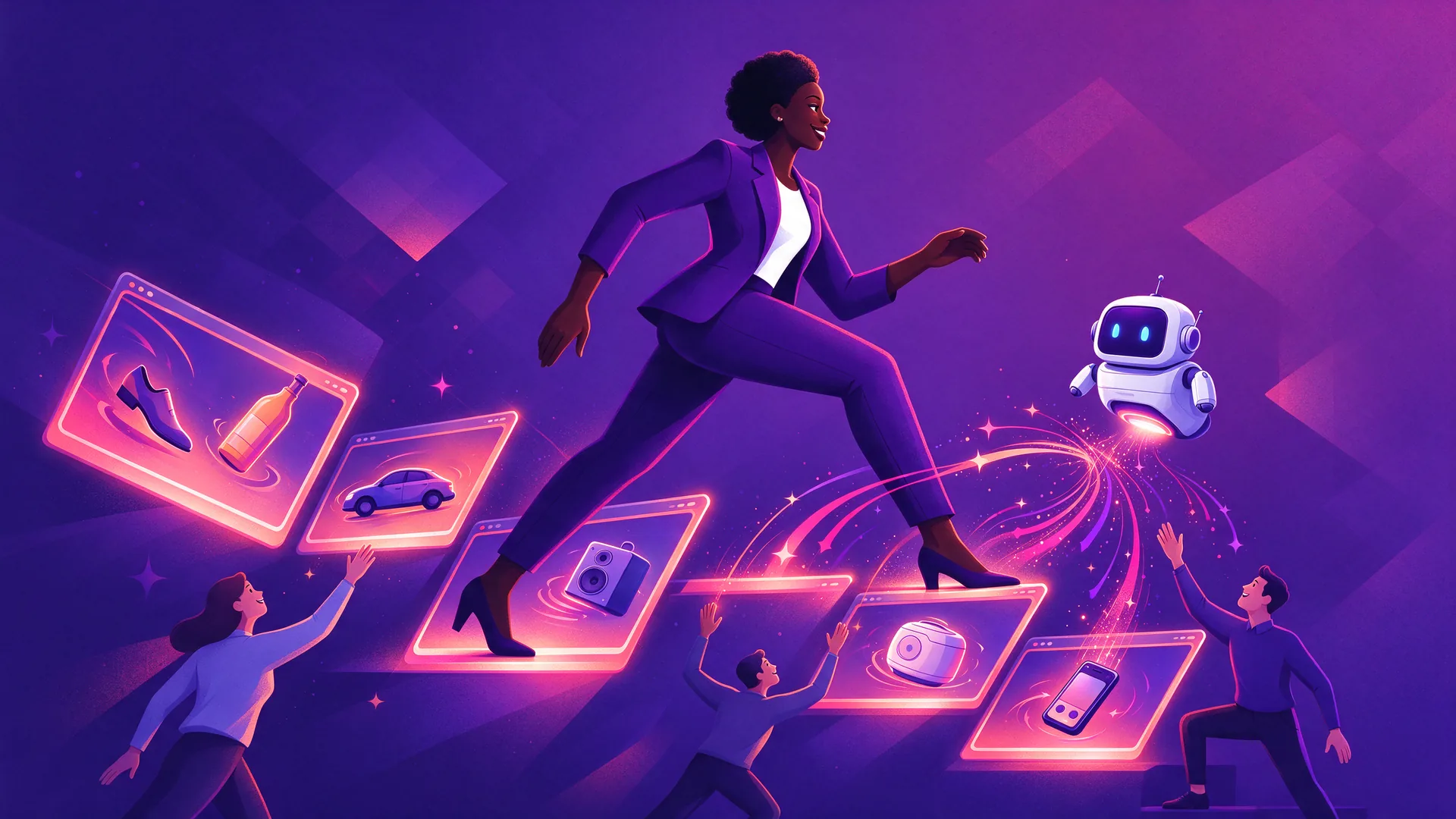
AI animation for B2B marketing is particularly interesting if you want to communicate complex propositions faster, more scalably, and more understandably. Think of an AI explainer video for software, a product animation for a technical solution, short formats such as AI animation for social ads for lead generation, or multilingual versions for international campaigns. The real gain usually lies not in "more video," but in smarter production: moving faster from briefing to first draft, varying more easily per target audience, and aligning better with different channels in the funnel.
This works well for B2B because decision-makers often have to process a lot of information in a short time. A strong animation makes abstract processes visual, accelerates understanding, and helps you consistently translate a single message across your website, sales, ads, onboarding, and e-learning. At the same time, it is true that AI is not a button that automatically produces a compelling marketing video. Without a strategy, script, direction, and quality control, you quickly end up with generic or messy output. That is precisely why many companies opt for a hybrid approach combining AI with creative custom work in 2D or 3D.
B2B marketing often revolves around products, services, or processes that cannot be explained in a single sentence. The more technical or abstract your offering, the greater the chance that text alone is not enough. AI animation helps you translate complex information into a visual story that is easier to understand.
This is particularly valuable in situations where your target audience has little time, needs to convince multiple stakeholders, or only proceeds once the business case is clear. A good animation can then help with:
Compared to traditional video production, AI often offers speed and scale. It is easier to create multiple versions, add languages via AI voiceovers or AI dubbing, and translate assets for social media, email, or presentations. For B2B teams with high content needs, this is a practical advantage, especially if marketing and sales want to use the same content base.
AI animation for B2B marketing involves the use of artificial intelligence within the process of business animation production and distribution. This can include AI text-to-video, image generation, voiceovers, automatic subtitling, multilingual dubbing, editing acceleration, or creating multiple creative variations based on a single concept.
Do you want an overview of definitions and possibilities? Read: What is AI animation?
It is important to note that AI in a professional B2B context usually does not take over the entire job. It is primarily used to make parts of the process faster and more scalable, while quality is monitored by humans. Examples include script choices, storyboard logic, timing, brand consistency, sound design, channel adjustments, and final editing.
In practice, this often results in a hybrid workflow:
That distinction is important, because many people search for "Which AI can create animations?" or "Can I use AI to create animations?" The answer is yes, but the better question for B2B is: how do you ensure that animation is also persuasive, aligns with your brand, and delivers results?
At the top of the funnel, AI animation helps to quickly grab attention and make a difficult subject accessible. Short AI social ads, animated explainers, and snackable variants for LinkedIn or display are often effective here. You can relatively easily test multiple angles, such as a problem-driven hook, an industry-specific message, or a variant per target group.
During the consideration phase, you want to offer more depth. This is where AI explainer videos and AI product animations excel, because they not only generate interest but also provide genuine explanations. Especially in software, high-tech, healthcare, finance, or industry, animation can visualize abstract functionality, data flows, or technical benefits without the need for live recordings. For SaaS products, a SaaS explainer often works particularly well to quickly clarify value and functionality.
Further down the funnel, you can use animation in sales presentations, follow-up emails, demo intros, or account-based outreach. A compact animation helps make a complex proposal shareable internally. This is valuable in B2B, where decisions often pass through marketing, management, procurement, and operations.
AI animation doesn't stop after the lead or deal. It is also a logical application in onboarding and customer education. Think of AI e-learning animations for software explanations, process training, safety, or internal adoption. This strengthens not only marketing but also activation and customer retention.
An AI explainer video is often the fastest way to make a complex product, platform, or process understandable. In B2B, this is important because many propositions revolve around abstract benefits such as efficiency, compliance, cost reduction, security, or integration. These are difficult to make tangible with text alone.
With animation, you can logically build cause, problem, solution, and result. AI accelerates elements such as script variations, voice-over selection, subtitles, and multilingual versions. This makes it easier to adapt a single core story for different markets or personas.
For technical products or systems, you want to show how something works, even if it is not easy to film. An AI product animation is suitable for clearly explaining functionality, process steps, internal components, or use cases. Especially in industry, engineering, healthcare, and high-tech, this can be much more impactful than a static brochure.
Product animations are useful for campaigns, website content, trade show screens, and sales support. If you need variants for different features, sectors, or languages, AI helps scale up faster without having to start from scratch every time.
B2B campaigns on LinkedIn, YouTube, or other channels often require multiple creatives. With AI social ads, you can create variations faster regarding the hook, length, CTA, visual composition, or proposition. This is useful for A/B testing and for campaigns where you want to reach different target audiences with the same basic message.
Especially if you regularly need new ads, AI can reduce production pressure. However, quality still depends on a strong concept, a sharp message, and consistent design. See also: ROAS with AI animation for social ads.
International B2B marketing often requires localization. AI voiceovers, AI dubbing, and AI subtitling make it easier to translate a single video into multiple languages without full re-production. This saves time and makes it feasible to work faster per country or market.
This is a major advantage, especially for product explanations, onboarding, e-learning, and campaigns with tight deadlines. Do ensure that the tone of voice, terminology, and timing remain consistent across languages so that the video continues to feel professional.
Anyone wondering "How can I make a corporate video with AI?" often turns to AI text-to-video. This allows you to convert a briefing, script, or URL into a first video concept faster. For B2B, this is useful in the early stages: to make ideas tangible, align internally, and move to a first version more quickly.
The best results are usually achieved when text-to-video is used as an accelerator, not as a final destination. The concept is brought to the table faster, after which style, storytelling, animation logic, and brand finishing are further refined.
Traditional B2B content such as white papers, landing pages, presentations, and static visuals remains important, but does not always have the same speed of understanding. Especially when a subject is technical, visual, or process-oriented, animation can offer a clear advantage.
| Content format | Strong in | Less strong in |
|---|---|---|
| Text and white papers | Depth, SEO, detail | Quick understanding, visual explanation |
| Static visuals | Quick to scan, compact | Process explanation, movement, timing |
| Live-action video | Humanity, brand experience | Abstract systems and technical visualization |
| AI animation | Complex explanation, scale, variants, localization | Works less well without strategy and creative direction |
For many B2B teams, therefore, the power lies not in replacing all forms of content, but in the combination. An animation attracts attention and accelerates understanding, while text, sales material, and follow-up content provide depth.
In practice, the question "How can I implement AI in marketing?" is rarely just about tooling. It is primarily about workflow, quality control, and clear choices. AI animation only delivers real value if you know in advance what the video is intended for within the funnel.
A workable approach usually consists of these steps:
This approach prevents AI from primarily producing a large amount of output without strategic coherence. This risk is particularly high in B2B, because multiple teams work with the same video. Marketing, sales, and customer success all benefit from one clear story that is consistent across all communications.
Much of the output in the market focuses on tools, but the strongest B2B animations still start with strategy. If you are not clear on what problem you are solving, who the video is intended for, and what action you expect, even the fastest AI workflow becomes inefficient.
Therefore, the script and storyboard are not old production steps that you can skip. On the contrary, they are the elements that determine whether a video feels logical. In B2B, they make the difference between "beautiful animation" and a "clear message".
A strong script for AI animation usually contains:
The storyboard translates that logic into visuals. Especially with technical or data-driven propositions, this prevents the animation from becoming too busy, too abstract, or too generic.
There are an increasing number of tools that support AI in animation, video composition, voice-over, captions, and localization. Which solution is best depends on your goal. You often need something different for a quick concept video than for a branded B2B campaign or technical product animation.
Broadly speaking, you can distinguish between:
For B2B marketing, the choice of tool is usually less important than the choice of production. If you require brand consistency, technical accuracy, and channel customization, you often end up with a hybrid process in which AI tooling is combined with an experienced studio approach.
Fully automated AI video may seem appealing due to its speed and low barrier to entry, but that approach often falls short as soon as the content becomes more complex or higher brand impact is required. This is particularly evident in B2B topics such as SaaS, industry, engineering, finance, or healthcare, where nuances are important.
A hybrid approach works better in this case because you benefit from speed without compromising on finish. AI assists, for example, with style development, text variations, voiceovers, subtitling, and editing acceleration, while creatives and producers handle direction, pacing, storytelling, and quality checks.
That combination is especially smart if you need:
Marketing primarily uses AI animation for campaigns, landing pages, product introductions, and social content. The benefits here lie in speed, more variations, and better reuse of a single concept across multiple channels.
Sales uses animation to explain propositions faster, strengthen follow-ups, and increase internal support among prospects. A good animation serves as a compact explanation that remains clear even without live commentary.
After the sale, AI animations assist with onboarding, adoption, and training. This makes the initial usage phase smoother, particularly for software, processes, and compliance topics.
The application is also logical internally. Think of e-learning, instructional videos, safety modules, or communication regarding change. This makes the same production logic more widely applicable than just marketing.
Make complex information clear, understandable, and convincing
An AI animation project rarely succeeds due to the tool alone. The briefing determines a great deal. The clearer you are about the target audience, channel, message, and desired action, the better the output aligns.
Ideally, include this in your briefing:
The more complex the content, the more value there is in a thorough intake and content alignment beforehand. This prevents the need for numerous revisions later on, where the video is visually appealing but factually incorrect.
AI makes production faster, but also increases the risk of quick errors. Especially in B2B, where credibility is important, those errors can directly come at the expense of conversion or trust.
That is precisely why review and QA are not a formality, but an essential part of professional AI animation.
You don't judge a good B2B animation solely on views. Which KPI is relevant depends on the channel and the goal. You look at awareness differently than you do for onboarding or sales support.
| Goal | Relevant KPIs |
|---|---|
| Awareness | view rate, watch time, engagement, CTR |
| Lead generation | CTR to landing page, conversion rate, cost per lead |
| Sales enablement | demo requests, meeting rate, follow-up interaction |
| Onboarding and training | completion rate, knowledge retention, activation, support reduction |
If you really want to learn what works, test variations in opening, length, CTA, and target audience approach. AI actually makes this easier, because you can have multiple versions produced faster from a single basis.
AI animation can have value in virtually every business market, but you see the benefits quickly, especially in sectors with complex content or longer decision-making processes. Consider:
In all these sectors, animation helps make specialized information understandable, shareable, and visually consistent. This makes it not only a marketing tool but also a communication tool more broadly within the organization.
Working with AI tools yourself can be fine if you want to quickly test concepts or need simple video variations. However, as soon as the stakes are higher—for example, with brand campaigns, technical product explanations, international rollouts, or content used jointly by sales and marketing—professional guidance is often a smarter choice.
Then you benefit not only from tooling, but also from factors that make the difference in final quality:
For companies that want to work with video structurally, this is usually more efficient than constantly correcting individual tool output. Those seeking a concrete next step can opt to have AI animation created as a way to combine speed and quality.

Is your question not listed? Feel free to ask.
Ask your questionYes, AI can assist with concept development, text-to-video, voiceovers, subtitling, dubbing, image generation, and variants at scale. For professional B2B marketing, it is usually strongest as part of a hybrid workflow with human direction and quality control.
There are various tools for text-to-video, avatars, voice-over, and AI video editing. The best choice depends on your goal. For branded B2B content, often no single tool is decisive, but rather the combination of tooling, strategy, and creative finishing.
Start with a clear briefing: target audience, goal, core message, and channel. Use AI to build an initial script, concept, or voice-over faster, and then work through the video with storyboard, branding, editing, and QA. This way, you get a corporate video that is not only made quickly but also convinces.
Do not implement AI as a standalone experiment, but per use case. Choose, for example, AI social ads, AI explainer videos, or multilingual dubbing. Link clear KPIs to these, establish quality criteria, and determine which steps will be automated and which will remain under human control.
Yes. AI animation is well-suited for LinkedIn, websites, landing pages, email, sales presentations, onboarding, and trade show screens. The most important thing is to adapt the length, message, subtitles, and visual composition to the channel.
An AI explainer video uses artificial intelligence to accelerate parts of the production process, such as scripting, voice-over, subtitling, or variations. The video format itself can still be custom-made. The difference, therefore, lies primarily in workflow and scalability, not just in style.
Yes, that is precisely where there is much to be gained. With AI voice-over, dubbing, and subtitling, you can create multilingual versions faster and localize campaigns for different markets. However, control over terminology and tone of voice remains important.
AI product animation is particularly suitable if you want to visually explain a technical product, platform, or process and live video is not practical or clear enough. Think of software, machines, industrial processes, medical applications, or data-driven solutions.
For teams that additionally want to focus on commercial impact, it is also relevant to look at how animation works within animation for sales and conversion, and to assess the cost of AI animation in advance.

Whether it concerns an ambition, product, process, technology, or idea: we make visible what makes it special and translate it into imagery that is clear, convincing, and impossible to ignore.